



Some PCs upgrading from Windows 11 23H2 or 24H2 to 25H2 have run into a confusing failure: "We couldn't update the system reserved partition," sometimes accompanied by error code 0x800F0922 or 0xC1900104.
A Microsoft Q&A thread describes the problem on devices with a 100MB EFI System Partition, or ESP. That doesn't mean every 100MB ESP is incompatible with Windows 11 or that Microsoft requires existing Windows 10 PCs to resize the partition before upgrading.
Microsoft's current deployment guidance calls for a larger ESP when configuring a UEFI/GPT disk today: at least 200MB on drives with 512-byte or 512e sectors and 300MB on 4K-native drives. Those figures are useful benchmarks, but they aren't published Windows 11 upgrade eligibility requirements for every existing installation.
This guide shows how to identify your EFI partition, understand the current sizing guidance, and troubleshoot the specific "We couldn't update the system reserved partition" error without treating a small ESP as proof that an upgrade will fail.
What's confirmed about this error, and what isn't
Insufficient space in the system boot partition can cause Windows upgrades to fail.
Microsoft's Windows upgrade error guidance says error 0x800F0922 can mean there isn't enough free space in the System Reserved partition. Microsoft also notes that the same code can mean the PC couldn't connect properly to Windows Update servers, including when a VPN interferes with the connection.
That makes the error code alone insufficient to diagnose an EFI partition problem.
The Windows 11 25H2 case above involved a 100MB ESP, while an independent administrator documented a similar failure on HP laptops during Windows 11 upgrades through SCCM or installation media. In that case, HP firmware files had consumed much of the available space inside the ESP.
A 100MB partition is therefore a possible risk factor on some systems, particularly when little free space remains. It isn't proof that the partition caused the failure.
Microsoft also still documents scenarios where a 100MB ESP is usable. Its MBR2GPT documentation says an existing system partition can be reused as the ESP when it is at least 100MB on a 512-byte-sector disk, provided it meets the tool's other requirements.
So don't resize or delete a partition based on its total capacity alone.
Windows 10 to Windows 11 partition layout: EFI, MSR, and recovery partitions
Part of the confusion comes from the error wording. On a UEFI/GPT system, the boot partition is the EFI System Partition. On an older BIOS/MBR installation, Windows uses a different System Reserved partition arrangement.
For a current UEFI/GPT deployment, Microsoft documents three separate supporting partitions around the main Windows partition:
EFI System Partition (ESP): FAT32 and used for UEFI boot files. Microsoft's current deployment minimum is 200MB for 512-byte/512e-sector drives and 300MB for 4K-native drives.
Microsoft Reserved Partition (MSR): 16MB on current GPT layouts. It has no drive letter and doesn't store ordinary user data.
Windows Recovery Environment partition: Separate from the ESP and used for WinRE.
The recovery partition has its own sizing rules and shouldn't be confused with the ESP.
Microsoft says the Windows RE tools partition must be at least 300MB. Current deployment guidance also says it should be large enough to hold winre.wim, any customizations, and sufficient free space for servicing. Microsoft's newer UEFI/GPT deployment guidance recommends allowing an additional 250MB of free space beyond the recovery image and customizations.
Those requirements don't determine whether the ESP has enough room for an operating-system upgrade. The partitions serve different purposes.
How to check your Windows 11 EFI system partition size
Before checking an ESP, confirm that the PC actually uses UEFI and GPT.
Press Windows+R, type:
msinfo32
and check BIOS Mode.
If it says UEFI, the system should use the UEFI/GPT partition model. If it says Legacy, the ESP sizing figures above don't apply in the same way.
To inspect the disk layout, open Command Prompt as administrator and start DiskPart:
diskpart
Then list the disks:
list disk
Identify the system drive by its size and other known details rather than automatically assuming it is Disk 0.
Select the correct disk:
select disk [disk number]
Then display its partitions:
list partition
These commands only display information.
On a UEFI/GPT system, the ESP is normally a small FAT32 system partition. If you can't identify it confidently, don't modify anything.
PowerShell can identify the partition by its standard GPT type instead. From an elevated PowerShell window:
Get-Partition | Where-Object {$_.GptType -eq '{C12A7328-F81F-11D2-BA4B-00A0C93EC93B}'}
That GUID identifies an EFI System Partition.
Compare its total size with Microsoft's current deployment benchmarks:
512-byte or 512e sectors: 200MB minimum for a newly configured ESP
4K-native sectors: 300MB minimum for a newly configured ESP
Again, those are Microsoft's current deployment figures, not an automatic requirement that every older Windows installation must satisfy before an in-place upgrade.
Total size also isn't the whole story. A 100MB ESP with substantial free capacity isn't equivalent to a 100MB partition nearly filled by boot files, firmware data, or other components.
If you're only checking the layout and haven't received an upgrade error, there is normally no reason to mount, resize, or alter the ESP.
What your findings mean
Don't resize or delete a partition solely because it's 100MB.
Here's how to interpret what you find:
ESP is 200MB or larger on a 512/512e drive, or 300MB or larger on a 4K-native drive: It meets Microsoft's current deployment sizing guidance. That doesn't guarantee an upgrade will succeed, because free space and unrelated upgrade problems can still matter.
ESP is around 100MB and you've had no upgrade error: Leave it alone. Its size doesn't prove an upcoming Windows upgrade will fail.
You've received "We couldn't update the system reserved partition": Check the actual error code in Windows Update history before assuming the ESP is responsible.
The code is 0x800F0922: Insufficient System Reserved/EFI space is one possible cause, but Microsoft says Windows Update connectivity or a VPN can also trigger the code.
The PC is an older OEM system: Check the manufacturer's support information before modifying its partitions, particularly if the ESP contains OEM firmware files.
Start with Microsoft's normal Windows Update troubleshooting before changing the disk layout.
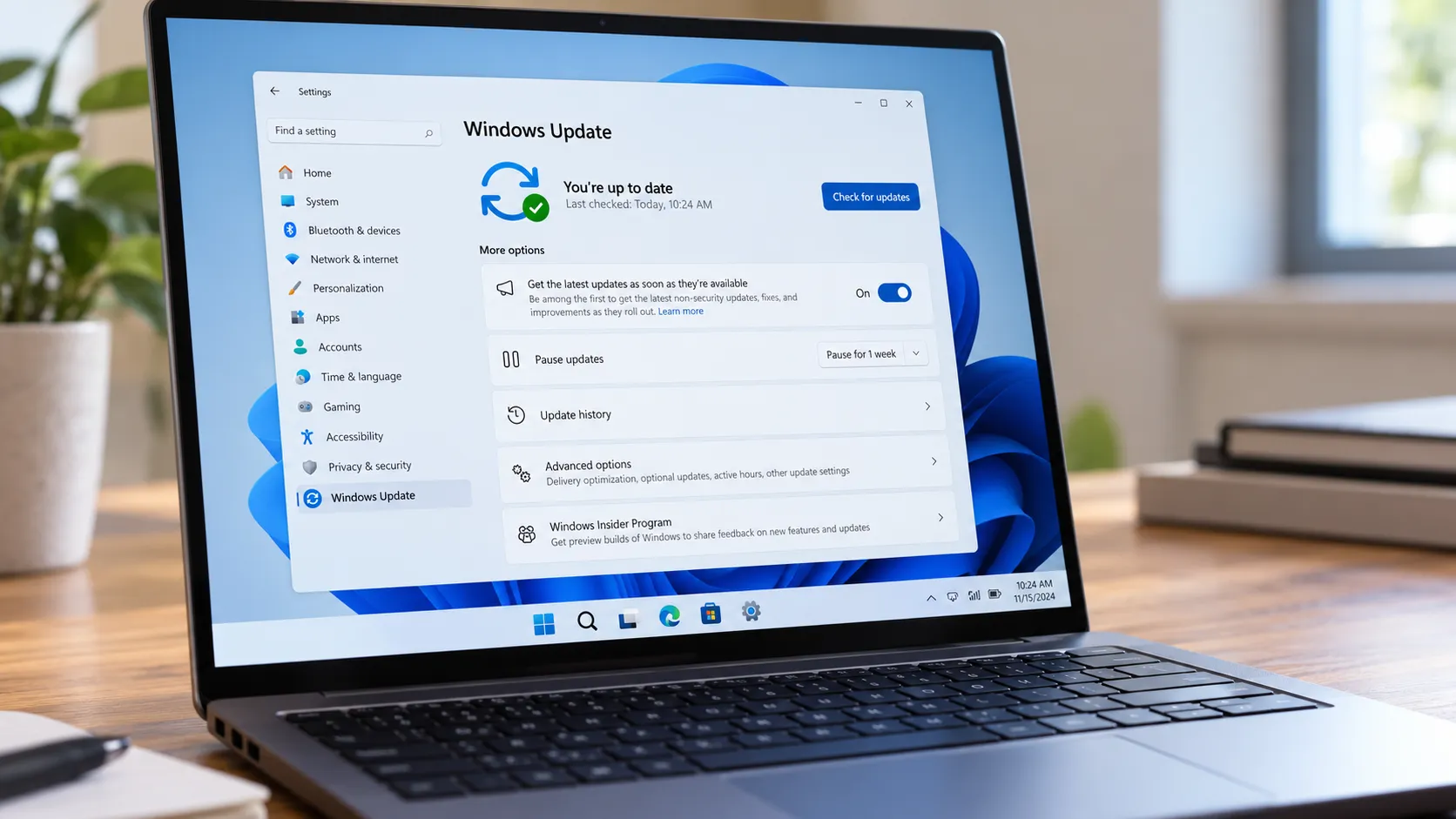
On Windows 11, go to Settings > System > Troubleshoot > Other troubleshooters > Windows Update > Run.
Restart the PC after the troubleshooter finishes, then try Windows Update again.
If preliminary checks don't clear the error
If the error persists and you've confirmed that insufficient ESP space is the likely cause, the next step depends on the PC's partition layout.
Microsoft says increasing the System Reserved partition can resolve 0x800F0922 when lack of free space is responsible. Partition resizing is potentially destructive, though, and Microsoft's support guidance doesn't prescribe one universal resizing procedure for every OEM disk layout.
Back up important files before modifying any partition.
Several more aggressive fixes circulate in community troubleshooting threads, including deleting boot-font files, removing OEM firmware files from the ESP, deleting and recreating the MSR, or manually resizing adjacent partitions.
Don't treat those as routine steps.
One independent HP-specific workaround removes an approximately 40MB firmware file from EFI\HP\DEVFW on affected HP machines. That procedure was created for a specific hardware configuration and shouldn't be applied to unrelated PCs.
Likewise, deleting the 16MB Microsoft Reserved Partition to create room beside the ESP is an advanced repartitioning procedure. A mistake can make Windows unbootable.
A clean installation is another option if normal repair methods fail, but it is destructive rather than the automatic "next step."
During a clean install, Windows Setup can recreate the necessary partition layout on unallocated space. That doesn't mean wiping the drive is required to solve this error.
If you choose that route, back up everything first and verify the correct physical drive before deleting any partitions.
What to do next
If you're planning a Windows 10-to-Windows 11 upgrade and haven't encountered a partition-related error, don't resize the EFI partition preemptively just because it is smaller than Microsoft's current deployment recommendation.
Check that the PC meets Windows 11's supported hardware requirements and proceed with the normal upgrade process.
If you receive "We couldn't update the system reserved partition," check the exact error code first. For 0x800F0922, run Microsoft's Windows Update troubleshooting steps and rule out update-server or VPN problems before treating the ESP as the cause.
If the evidence does point to insufficient EFI partition space, back up the system and check the PC manufacturer's guidance before modifying the disk layout.
A 100MB ESP can be part of the problem on some older systems, especially when it is nearly full. It isn't, by itself, proof that a Windows 10-to-Windows 11 upgrade will fail.

Comments
Be the first, drop a comment!