



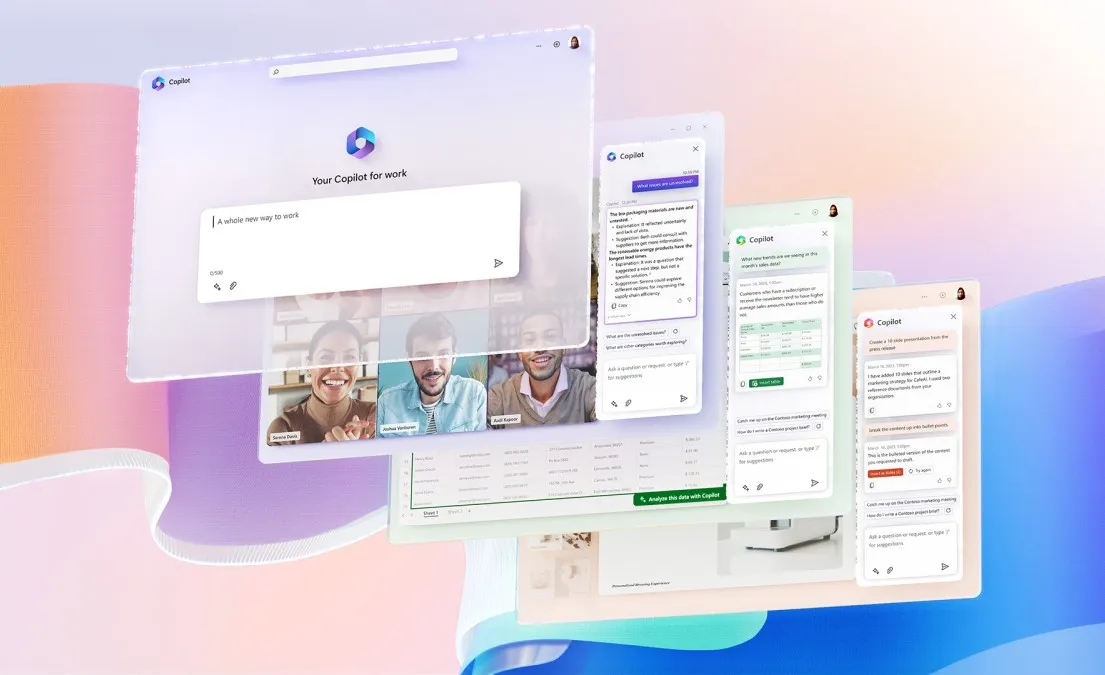
Microsoft has turned Copilot in Excel from a chat-based assistant into a tool that can edit workbooks directly. That change matters more in shared files, where multiple people may be changing formulas, formatting, charts, and data at the same time.
Microsoft has also expanded the controls around those edits. Copilot now offers Edit, Plan, and Chat modes, while Excel's existing Show Changes and Version History tools provide a longer-lived record after the temporary highlights from an active Copilot session disappear.
That closes one of the biggest gaps in Microsoft's early 2026 rollout. Copilot edits are no longer visible only through temporary green tabs and highlighted cells. Excel can track supported changes for up to 365 days, and Copilot itself can summarize that history, including changes attributed to Copilot.
A separate issue remains: what Copilot can access because of permissions a user already has. Edit tracking tells a team what changed inside the workbook. It does not fix overshared SharePoint or OneDrive content that Copilot is already allowed to discover.
Copilot can now edit Excel workbooks directly
Copilot in Excel currently offers three modes: Edit, Plan, and Chat.
In Edit mode, Copilot can make direct workbook changes using Excel's native tools. Microsoft says that includes adding or deleting worksheets, changing cell values, creating formulas and PivotTables, applying formatting, and restructuring workbook content.
Microsoft's current Copilot in Excel documentation says Edit mode is the default experience.
Chat mode keeps Copilot's response inside the conversation instead of changing the workbook.
Plan mode sits between the two. It creates a proposed step-by-step approach first so the user can review it before Copilot starts editing.
That is particularly useful for a shared workbook where a prompt such as "clean up this forecast and rebuild the summary" could otherwise result in several different changes across multiple sheets.
Copilot can also use Python during editing for more advanced analysis, transformations, simulations, and visualizations.
Plan Mode is now a current feature
The rollout status has changed since Microsoft's April announcement.
Plan Mode was initially listed as in development with general availability targeted for May 2026. Microsoft's current support documentation now lists it as an available Copilot in Excel mode on:
Windows
Mac
Excel for the web
Plan Mode is also available on iPad, although Microsoft's current platform table says direct Edit mode is still rolling out there.
On iPhone and Android, Microsoft currently lists Chat mode rather than the full Edit and Plan experience.
That means the old question of whether Plan Mode ever reached general availability is no longer unresolved. Microsoft now documents it as part of the current Excel Copilot interface on its supported desktop and web platforms.
Temporary Copilot edit indicators still disappear
The visual cues introduced earlier in 2026 still serve a different purpose.
During a Copilot turn, Excel highlights cells being changed and marks modified worksheets with a green tab indicator. Those cues help the person running Copilot follow what is happening while the task is in progress.
They are temporary.
Microsoft says the indicators clear when the Copilot turn is finished.
That makes them useful for immediate review, but they are not the long-term record of what happened in a shared workbook.
For that, Excel now points users toward change history.
Copilot edits can appear in workbook change history
This is the biggest change from the earlier documentation.
Microsoft now explicitly documents Copilot access to Excel change history.
A user can ask Copilot questions such as:
What changed in this workbook?
Who changed the values on a particular sheet?
What changed during the past seven days?
What changes has a particular person made?
What changes has Copilot made to this workbook?
Copilot answers using the workbook's underlying change history.
Excel's separate Review > Show Changes pane lets users inspect that record directly without relying on an AI summary.
Show Changes can display:
Who made the change
Where the change occurred
When it happened
What changed
The previous cell value where supported
Microsoft says supported changes can remain available for up to 365 days.
That makes the current system substantially more durable than the temporary highlights shown during a Copilot turn.
Change history still has limits
The current tracking system is not a complete forensic record of everything that can happen inside Excel.
Microsoft says Copilot can report only changes that exist in the workbook's change history.
Some edits may be missing if they were made using an unsupported version of Excel or through a feature that Show Changes does not track.
That distinction matters for teams relying on the history for review.
A clean Copilot summary does not prove that every possible workbook operation was captured. It proves that Copilot summarized the supported changes Excel recorded.
For a broader rollback, Microsoft still recommends Version History.
In a coauthored workbook stored in OneDrive or SharePoint, Version History can open earlier saved versions of the complete file and restore one if necessary.
Show Changes is therefore better for tracing individual supported edits. Version History is the stronger recovery option when a team needs to roll back a larger set of changes.
What coauthors see when Copilot edits a shared workbook
Microsoft's current FAQ is clearer here than the early announcement was.
When Copilot edits are saved to a workbook, other people with access can see those changes, including users working in the workbook during the same coauthoring session.
Ordinary Excel coauthoring still applies.
Changes can appear to other collaborators as they are saved, and users can see who else is actively editing the workbook.
That does not mean every collaborator sees the same temporary Copilot highlights shown to the person running the prompt.
Microsoft documents the durable workbook changes and shared change history more clearly than it documents whether every transient Copilot visual cue is mirrored identically on every coauthor's screen.
The practical review tools are therefore:
Copilot's temporary grid highlights during the active turn
Show Changes for supported cell-level history
Copilot's own summaries of that history
Version History for full-file recovery
Microsoft also has Copilot audit data, but it is different
Microsoft 365 administrators have another layer of visibility through Microsoft Purview.
Microsoft says Copilot interaction data can be audited and retained, including prompts, responses, and referenced content.
That is not the same thing as Excel's Show Changes pane.
Purview is aimed at compliance, security, and investigation across Microsoft 365. Excel change history is aimed at understanding workbook edits.
An administrator therefore should not treat either system as a complete replacement for the other.
For a finance or operations workbook, a reasonable control stack is to use Excel change history for workbook review and Microsoft 365 compliance tooling where the organization needs broader records of Copilot activity.
Copilot can surface data the user already has permission to access
The second issue is separate from edit tracking.
Microsoft directly confirms that Copilot uses Microsoft Graph to ground responses in organizational data the signed-in user is authorized to access.
That can include documents, email, chats, meetings, and other Microsoft 365 content.
Microsoft's current privacy and security guidance is explicit that Copilot does not grant a user new permissions. It respects the access controls already in place.
That does not eliminate oversharing risk.
Microsoft now warns administrators directly that poorly governed or overshared content can affect Copilot results.
A SharePoint file available to an overly broad group remains available because the permissions already allow it. Copilot can make that content easier to discover without bypassing the permission system.
That is a governance problem rather than Copilot secretly granting itself access.
Edit tracking does not fix overshared files
Plan Mode, Show Changes, and Version History all address what happens after somebody starts working in a workbook.
They do not repair permissions elsewhere in Microsoft 365.
If a user can already open an old SharePoint document, Copilot may also be able to use that document as context where the product and tenant configuration allow it.
Microsoft recommends addressing oversharing through SharePoint permissions, restricted content discovery, restricted access controls, sensitivity labels, and other governance tools.
That work has to happen at the content and permission layer.
A green worksheet tab cannot tell an administrator that an employee has access to a forgotten folder containing sensitive material.
The two questions therefore remain separate:
What did Copilot change in this workbook? Use Copilot change-history queries, Show Changes, and Version History.
What information can Copilot reach? Review Microsoft 365 permissions, sharing, sensitivity labels, and governance controls.
Connected-experience settings can disable Copilot
Microsoft also confirms that privacy settings can affect whether Copilot is available in Excel.
If an organization turns off connected experiences that analyze content, Copilot features are unavailable in Excel and several other Microsoft 365 apps.
The same applies when all connected experiences are disabled.
This is an administrative control over whether the service can operate, not a workbook-level edit-tracking feature.
Microsoft also says prompts, responses, and organizational data accessed through Microsoft Graph are not used to train its foundation models for commercial Microsoft Copilot.
Copilot availability varies by license and tenant
The licensing picture has also moved beyond the simpler split between "free web Copilot" and a single paid work-based license.
Microsoft's current Excel documentation lists support through several subscription types, including qualifying personal plans, Microsoft 365 Premium, commercial Microsoft Copilot subscriptions, and eligible business or enterprise Microsoft 365 plans.
Commercial users may see labels such as M365 Copilot Premium or M365 Copilot Basic, depending on licensing and tenant configuration.
Microsoft's current Excel Copilot FAQ says Premium users receive priority access, while Basic users have standard access.
Feature availability can still depend on platform, software version, tenant settings, update rollout, and administrator controls.
Two people in the same organization can therefore encounter different Copilot availability without anything being wrong with the workbook itself.
What teams should check in a shared workbook
For collaborative Excel files where Copilot can make direct changes, four checks are useful.
Use Plan Mode for higher-impact work. Review the proposed steps before allowing a broad transformation across several sheets.
Review Show Changes after important edits. Don't rely only on the temporary cell highlights from the Copilot session.
Use Version History before major recovery work. It provides a complete saved version to restore when reversing individual edits would be impractical.
Audit permissions separately. A well-tracked workbook does not mean the rest of the user's Microsoft 365 access is appropriately scoped.
Teams can also disable AutoSave temporarily when experimenting with Copilot in a workbook, then review the result before saving it. Microsoft specifically recommends caution with direct Copilot edits in sensitive or shared files.
What's still missing
Microsoft has closed more of the edit-visibility gap than its April announcement originally documented.
Plan Mode is now a current feature. Show Changes provides a persistent record of supported workbook edits for up to 365 days. Copilot can query that history and identify changes attributed to Copilot itself. Version History gives teams another recovery layer.
The remaining gaps are narrower.
Not every type of Excel change is guaranteed to appear in Show Changes. Microsoft does not document every transient Copilot highlight as a shared signal visible identically to every coauthor. And workbook tracking does nothing to correct organization-wide permissions that were too broad before Copilot arrived.
For shared workbooks, the current controls are more than an in-session review layer. They now provide durable change tracking and recovery options.
They still are not a complete governance system on their own. Permissions, sensitivity controls, compliance logs, and workbook-level change history solve different parts of the problem.





Comments
Be the first, drop a comment!