



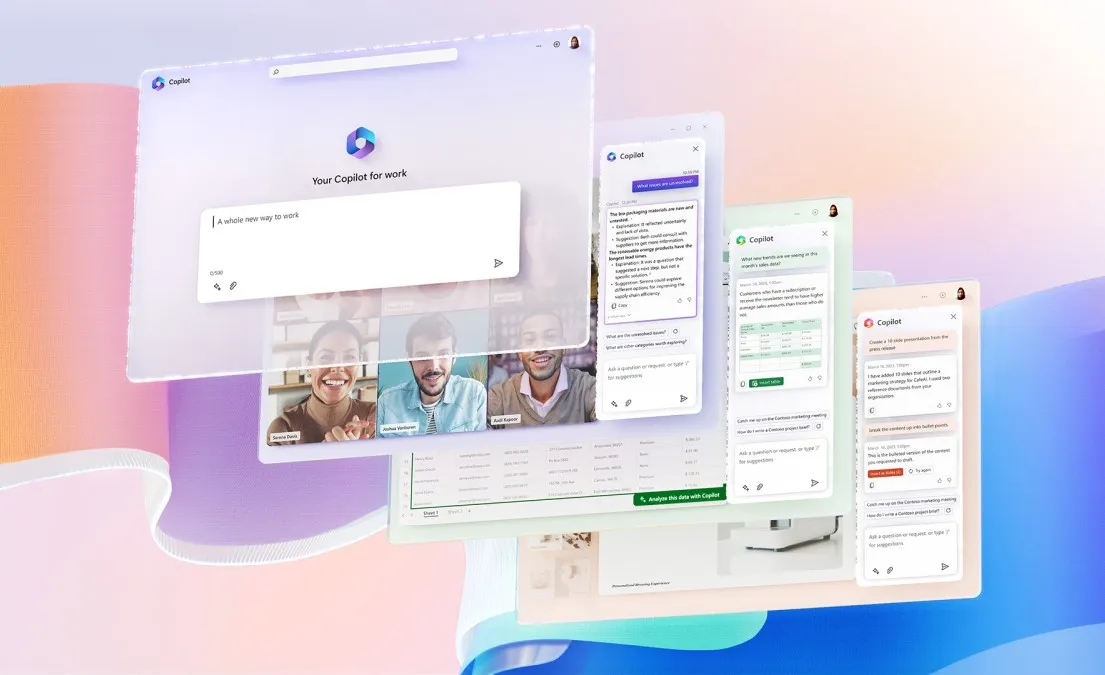
Microsoft has crossed a meaningful threshold in how AI operates inside Excel. The latest update to editing with Copilot in Excel turns Copilot from a suggestion engine into an agent that can act directly inside a live workbook, creating PivotTables, generating forecasts, and executing multi-step tasks from a plain-English prompt, without a user clicking through each step.
Mukul Singh, Microsoft's director of science who led the project, said in a Microsoft Command Line interview earlier this year that he believes Excel is "the first large-scale enterprise app that was actually automated by an agent."
The capability is real and documented. So is the reliability problem. Independent research published earlier this year found that GPT-based spreadsheet tools can produce well-structured outputs but are "inconsistent and often non-reproducible," with researchers identifying overconfident outputs and the absence of any built-in verification workflow as the two core failure modes — conditions that make skilled human review essential before any professional use.
What's available now with edit with Copilot in Excel
Copilot now takes direct action inside a workbook rather than recommending steps for the user to complete. It can infer data fields from a structured table, build a PivotTable on a new worksheet, add slicers, and apply filters all from a plain-English prompt. The canonical example Singh describes is simply typing "add a pivot table." That request now executes.
Excel has native forecasting tools, including Forecast Sheet and FORECAST.ETS, and Copilot can help users generate formulas and Python analyses. Microsoft's current documentation does not establish that editing with Copilot automatically selects between Forecast Sheet, ARIMA, and ETS in the manner described here.
Availability, though, is uneven. Microsoft introduced Agent Mode in Excel through its Frontier preview program on September 29, 2025. Microsoft now markets the capability as editing with Copilot, but access still depends on the user's client, license, language, and organizational settings.
The =COPILOT() function was in Beta Channel for Windows and Mac as of August 2025; web Excel support was listed as "coming soon" at that time. Python availability depends on platform, license, and organizational configuration; Microsoft currently supports Python in Excel on Windows, the web, and Mac.
The gap between what shipped and what's accessible to a given organization matters. So does the question of whether what's accessible is trustworthy enough for the contexts where Excel actually gets used: finance closes, budget variance reviews, board materials.
The technical shift that made agentic Excel possible
Singh's team started from a specific insight: Excel has its own internal logic, formula engine, and programming model, and general-purpose AI models had never been trained to understand it. It functions like an obscure programming language representing less than 0.1% of the broader coding ecosystem, meaning the model couldn't extrapolate from what it already knew. Solving that required roughly 17 to 18 research papers produced over two to three years, Singh explained.
The model capability gap was equally significant. Early GPT-4-class models couldn't sustain the sequences of discrete actions needed to complete complex spreadsheet tasks. They would collapse after a handful of steps. OpenAI's first generation of reasoning models was a turning point, but even those could reach 20 or 30 tool calls and still fail on genuinely difficult workbooks. The current generation of models is what made reliable multi-step action practical, according to Singh.
Latency remains the friction point. Microsoft's customer research produced a hard finding: not a single user was willing to wait more than one minute for an agent-driven result. Singh cited the spreadsheet agent Shortcut, whose product could run a single query for 25 minutes. Users eventually accepted it only because the task was async. They submitted the query and stepped away.
Where it falls short: reliability, oversight, and the overtrust risk
The reliability gap is documented. GPT-based spreadsheet tools tested against structured modeling criteria earlier this year produced well-structured outputs but failed consistently on reproducibility. The same prompt run twice yielded different results. Researchers labeled the core problems "the problem of confidence" (AI outputs carry an authoritative tone regardless of accuracy) and "the problem of workflow" (no built-in process for verification). Current tools require skilled user review before any professional application.
Hallucinations are real, but they may not be the biggest risk. A December 2024 paper argues the more significant threat is what happens to user judgment over time: as more decisions get delegated to the agent, the critical-thinking habits needed to catch errors erode. LLMs produce probabilistic outputs they possess no actual knowledge, yet users routinely treat confident-sounding results as authoritative.
The stakes are not hypothetical. A well-documented 2020 case saw 16,000 COVID-positive test results lost in the UK because a spreadsheet file was silently truncated at its row limit an error that delayed the reporting of 15,841 positive tests. A later study estimated that the delay might have contributed to more than 1,500 deaths, but Public Health England disputed that conclusion, and the researchers described confidence in the estimate as low.
What safe deployment actually requires
The enterprise question is no longer whether Copilot can touch a workbook. It can. The question as RowSpeak's governance analysis framed it earlier this year is whether the organization can build an approvable workflow around it.
Microsoft says Copilot respects existing Microsoft 365 protections, including locked cells, sensitivity labels, DLP policies, and admin controls via the M365 Admin Center, according to DataStudios. Those controls set a floor. Building an auditable workflow requires more.
Enterprise governance guidance recommends a staged approach: start with bounded, lower-stakes tasks monthly variance summaries, sales dashboards, inventory reports and keep human review mandatory for any output that informs a consequential decision. Separating deterministic calculations from AI-generated interpretation matters, as does preserving logs and version history before expanding scope. Expand once the organization trusts the workflow, not before, per RowSpeak.
The governance framework and the technology need to move at the same pace. Right now, the evidence suggests they don't.
What this means beyond Excel
The same research team that built agentic capability in Excel used the identical pattern to ship equivalent features in PowerPoint, Word, and Outlook. Singh said Excel "showed the way," proving both that automating a major enterprise app through AI was possible and that there was genuine appetite for it. The governance questions raised here reproducibility, oversight, audit trails, separation of AI interpretation from deterministic outputs will surface across every Office application over the coming years.
For everyday Excel users, the PivotTable and forecasting features are worth exploring in low-stakes workflows today. For IT admins and enterprise teams, the work is establishing the audit infrastructure, access controls, export logs, and review gates before broader deployment, not after. The available research supports requiring skilled verification, although the cited study evaluated a third-party GPT spreadsheet tool rather than Microsoft's current editing-with-Copilot implementation.





Comments
Be the first, drop a comment!