



Reviewed by: Y. Garcia
Millions of Microsoft 365 subscribers pay a recurring fee to do two things, mostly: write documents and build spreadsheets. LibreOffice, a free Microsoft 365 alternative that's been around for more than a decade, already handles both, with no subscription, no ads, and no account required.
LibreOffice is a full office suite, word processor, spreadsheet, presentation software, and more, that runs entirely on your own machine instead of requiring the cloud. The Document Foundation released version 25.8 on August 20, 2025, describing it as a viable alternative to proprietary office suites for individuals, schools, businesses, and public institutions.
The suite's code is open for public inspection, and version 25.8 runs on Windows, macOS, and Linux, with builds for Intel and ARM/Apple Silicon chips. Version 25.8 is no longer the current release, however: The Document Foundation moved to the 26.2 branch in 2026, and the 25.8 branch reached the end of its maintenance cycle in June.
What matters just as much is how LibreOffice handles Microsoft's DOCX, XLSX, and PPTX files and whether it fits into the collaboration tools, Teams or SharePoint among them, that many workplaces now build their document workflows around. The Document Foundation says LibreOffice can open and save Microsoft's Office Open XML formats and specifically highlighted improved DOCX, XLSX, and PPTX interoperability in version 25.8.
This piece sticks to what The Document Foundation's own materials confirm about LibreOffice 25.8 and flags where compatibility or workflow differences still need to be tested, so anyone considering the switch knows what to check first.
LibreOffice 25.8 features: what the release actually confirms
The release notes are specific about a handful of things. LibreOffice 25.8 contains no advertising, no data tracking, and no subscription fee. Every feature runs locally on the user's own computer, with no internet or cloud connection needed for local use.
The source code is open for public inspection and free of proprietary technology constraints, which The Document Foundation frames as one of the suite's core selling points as an open-source Microsoft Office replacement. That openness is verifiable by anyone with the technical background to check it.
On performance, The Document Foundation reports that Writer, the word processor, and Calc, the spreadsheet application, open files up to 30% faster than before, according to its own benchmark tests. Those two applications are the ones the release material names directly.
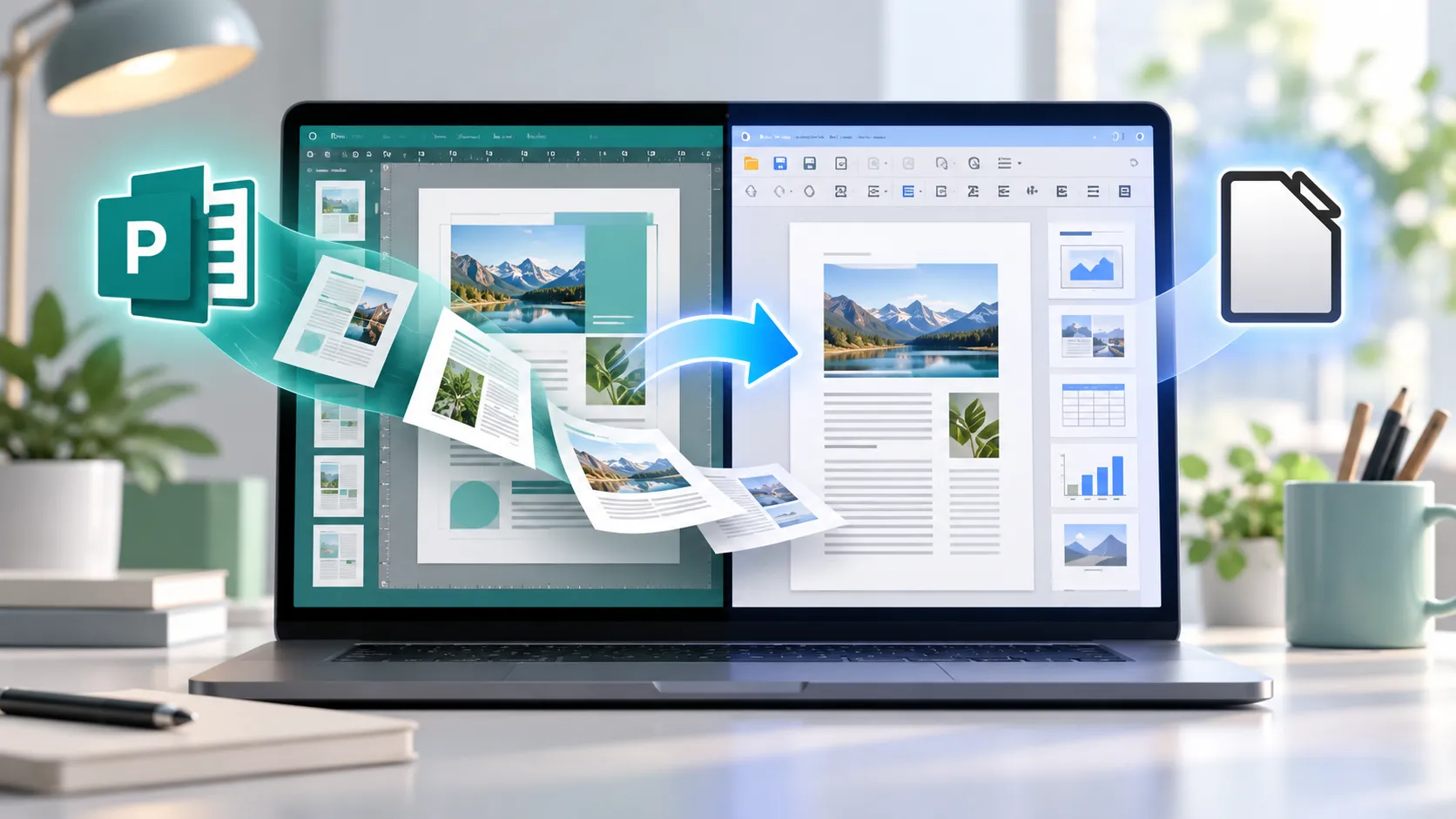
The 25.8 release also specifically cites better interoperability with Microsoft Office files, including more accurate handling of DOCX, XLSX, and PPTX files and fewer formatting problems. LibreOffice's documentation confirms that current versions can open and save those formats, although compatibility with individual documents can still vary depending on features, formatting, macros, and other file-specific elements.
On privacy, The Document Foundation states that LibreOffice collects no personal data, usage metrics, or diagnostic information by default and says it complies with data-protection requirements used in public-sector deployments, including GDPR. The project also documents optional telemetry that requires user consent, so the more precise claim is that LibreOffice does not collect or send personal data without the user's consent.
Who gets the clearest benefit: solo and offline work
Local execution suits a specific kind of workday: one person, one machine, no dependence on a company server. Eliane Domingos, chairwoman of The Document Foundation, described the project's purpose as letting people "work securely, independently and confidently."
That phrasing lines up with one of the clearest benefits of the desktop suite: a user can open a file, make changes, and save it locally without relying on cloud storage. That is a meaningfully different model from a team workflow where several people might edit the same document at once through OneDrive, Teams, or SharePoint.
LibreOffice is not limited to one-person workflows, though. The Document Foundation says self-hosted collaboration is possible through integrations with on-premises cloud platforms such as Nextcloud. That is different from native Microsoft 365 collaboration and should be evaluated separately.
Anyone whose work is mostly self-created, drafts nobody else touches, spreadsheets built and used solo, or notes that never leave one laptop is still among the clearest audiences for the desktop suite. No subscription fee, no advertising, no required cloud dependency for local use, and strong user control over local files make a straightforward case for that kind of workflow.
Is LibreOffice a free alternative to Microsoft 365 for teams?
Here's where two questions need to be separated.
The first is file-format compatibility: does a Word document, Excel workbook, or PowerPoint deck built in Microsoft's software open correctly in LibreOffice? LibreOffice supports DOCX, XLSX, and PPTX, and version 25.8 included interoperability improvements intended to reduce formatting problems.
Support does not mean every file will reproduce perfectly. Complex formatting, macros, formulas, tracked changes, comments, fonts, and slide layouts are the kinds of elements worth checking with the actual files a workplace relies on.
The second question is collaboration-platform integration: can LibreOffice plug into the tools a team already uses for real-time coauthoring, files synced through OneDrive, or document libraries hosted in SharePoint? LibreOffice can participate in collaborative setups through options such as Nextcloud, but that is not the same workflow as Microsoft's native Teams, OneDrive, and SharePoint integration.
A suite could handle Microsoft file formats reasonably well and still be a poor fit for a Microsoft-centered collaboration environment. Anyone weighing LibreOffice for team use should test file compatibility and collaboration requirements separately rather than assuming a pass on one covers the other.
If a workday runs mostly through documents nobody else touches, this gap barely matters. If it runs through shared drafts, simultaneous edits, and files that move constantly between coworkers, this is the part of the decision that deserves the most testing.
Is it still being maintained?
A common worry about free, open-source software is that it quietly stops getting updates. LibreOffice's release history gives a clear answer: development is ongoing.
LibreOffice 7.6.7 arrived in May 2024 as the final maintenance release in the 7.6 line, but it was not the project's last major release before 25.8. LibreOffice also released the 24.2, 24.8, and 25.2 branches before version 25.8 arrived in August 2025.
The project now uses a year.month versioning system, with major releases generally identified by their release year and month. LibreOffice moved on to the 26.2 branch in 2026, while support for the 25.8 branch ended in June 2026.
Windows, macOS, and Linux remain supported platforms, although minimum operating-system requirements can change between release branches.
Before you download: a free office suite for Windows, but check your OS first
System requirements shift between versions, sometimes by more than expected. The move from the 7.6 line to 25.8 illustrates that clearly.
LibreOffice 25.8 no longer runs on Windows 7, Windows 8, or Windows 8.1, and it is the last branch to support macOS 10.15. Support for 32-bit x86 Windows is deprecated.
LibreOffice 7.6.7 from May 2024 listed Windows 7 SP1 and macOS 10.14 as minimum requirements.
Current 26.2 releases raise some requirements again, including Windows 10 for standard 64-bit Windows builds and macOS 11 for the 26.2 Mac branch.
That's a real narrowing of supported systems over successive release cycles. Anyone running an older machine should check the requirements for the current LibreOffice release rather than assuming a version discussed in an older article will still be the recommended download.
Where LibreOffice fits
Solo, offline, or privacy-conscious work. Documents created and used by one person, on one machine, with no need to sync through a company cloud. This is where LibreOffice's pitch, no subscription, no advertising, and no required cloud dependency for local use, lines up cleanly with what The Document Foundation states about the product.
Occasional Microsoft file exchange. LibreOffice supports DOCX, XLSX, and PPTX and continues to improve interoperability, but complicated files should still be tested directly.
Real-time coauthoring or Teams- and SharePoint-centered teams. LibreOffice supports collaborative setups through options such as Nextcloud, but it does not reproduce Microsoft's native Microsoft 365 workflow. Teams that depend heavily on OneDrive, Teams, or SharePoint should test those requirements before switching.
None of these categories is permanent. Compatibility and collaboration support continue to change across LibreOffice releases, which is another reason to test the current version rather than judging the suite only by version 25.8.
Open the most complicated Word document and Excel spreadsheet on hand, the ones with tracked changes, macros, or nested formulas, inside LibreOffice and see what survives. This is a quick way to identify problems in your own files.
It won't settle every collaboration question, but it costs nothing but a few minutes, and it is more useful than assuming that support for a file format guarantees identical behavior across two different office suites.


Comments
Be the first, drop a comment!