





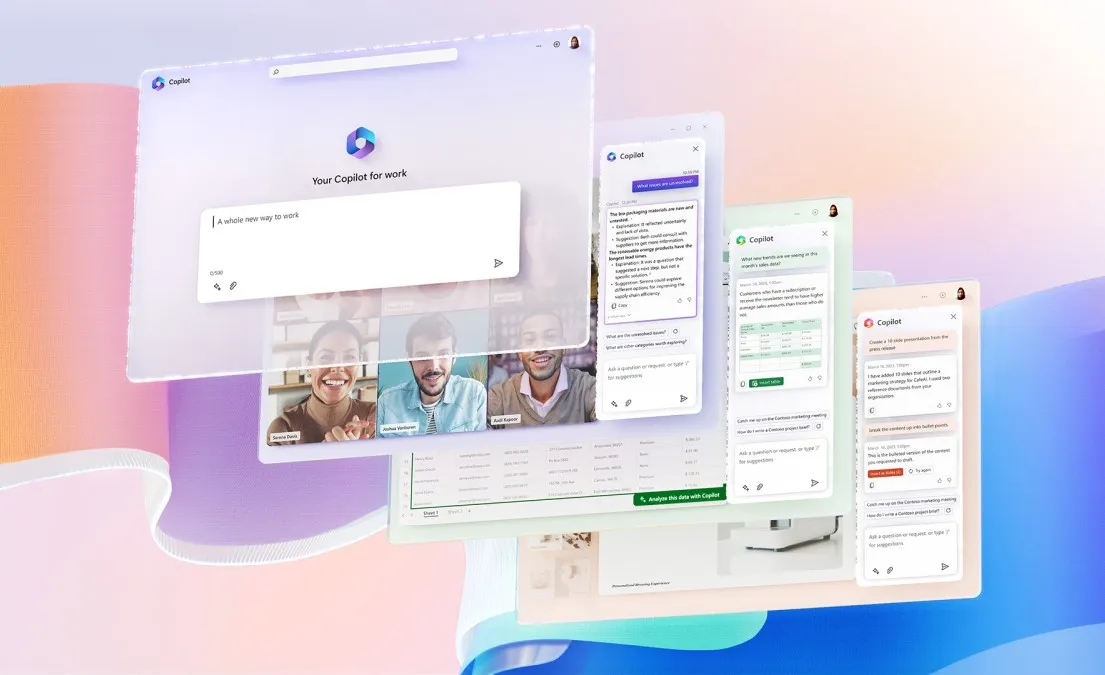
Microsoft and NVIDIA are both talking about local AI on Windows right now, but they're describing two products at very different stages of readiness. One is Microsoft Copilot+ PC local AI processing, a hardware certification already sitting on store shelves. The other is NVIDIA's RTX Spark, a GPU/CPU "superchip" that exists mostly as company specifications and a fall ship date. If you're shopping based on either company's local-AI claims, it matters which one you're actually comparing.
Copilot+ PCs require a compatible processor with a 40+ TOPS NPU — currently AMD Ryzen AI 300/400 series, Intel Core Ultra 200V/300V series, or Snapdragon X series — plus 16GB of RAM and 256GB of storage. That hardware already ships from several vendors. NVIDIA's RTX Spark, unveiled jointly with Microsoft four months ago, is something else entirely: a Blackwell GPU and Grace CPU linked together, with up to 1 petaflop of AI compute and 128GB of unified memory.
NVIDIA says RTX Spark laptops and compact desktops from ASUS, Dell, HP, Lenovo, Microsoft Surface, and MSI ship this fall, with Acer and GIGABYTE models to follow. This article breaks down what current Copilot+ PCs run locally today, which RTX Spark claims belong to that specific machine versus the broader RTX lineup, why "40 TOPS" and "1 petaflop" describe two different kinds of specs, and what buyers can actually verify before choosing either platform.
What Copilot+ PCs actually run locally today
To qualify, a device needs a compatible processor or SoC with a 40+ TOPS NPU, at least 16GB of DDR5/LPDDR5 memory, 256GB of SSD/UFS storage, and Windows 11.
That NPU is doing narrower work than the branding suggests. Microsoft describes it as built for small language models handling bounded tasks: semantic search across files and settings, Click to Do shortcuts on text and PDFs, Windows Studio Effects for video calls, and a Settings agent that can suggest an action for plain-language requests, such as increasing cursor size when a user types "my mouse is too small." It's a suggestion engine for specific settings, not a guarantee that every Copilot feature stays off the cloud.
Microsoft is explicit about the rest: the NPU handles what it can locally, and when the device is online, it can work alongside cloud processing for larger or more extensive requests. Windows 11 local AI on a Copilot+ machine is a hybrid system by design, not a fully offline one.
That distinction matters because Copilot is available on Windows 11 PCs regardless of whether they qualify as Copilot+ PCs, regardless of hardware. Not every Windows laptop qualifies as a Copilot+ PC. Copilot+ is a distinct hardware class built around that 40+ TOPS NPU requirement, which is why it isn't something a non-qualifying laptop can gain through a software update. This is the documented, working floor of Microsoft's local-AI strategy. NVIDIA's pitch starts from a different baseline entirely.
What NVIDIA claims RTX Spark adds, and what's just RTX
NVIDIA's own materials describe RTX Spark as capable of running 120-billion-parameter language models with up to 1 million tokens of context, generating 4K AI video, and editing 12K footage locally, built around a Blackwell RTX GPU linked via NVLink-C2C to a 20-core Grace CPU. Those are NVIDIA-sourced specifications. None of it has been independently benchmarked yet.
Some of the most eye-catching numbers in NVIDIA's announcement don't actually describe RTX Spark. A 2x throughput gain on certain AI models was measured on a GeForce RTX 5090. Studio Voice now extends down to RTX 3060 GPUs, and FLUX image generation is already shipping on ASUS ProArt laptops. Those are broader RTX ecosystem updates that appeared in the same announcement; they don't automatically carry over to a Spark machine.
The clearest Spark-specific example involves Adobe. NVIDIA says it's partnering with Adobe to rebuild Premiere's video pipeline around Spark's unified memory, Blackwell GPU, and TensorRT software, with updates expected to roll out alongside Spark's fall availability. That's a named product, a named workflow, and a stated timeline, which is more concrete than most of the surrounding claims.
On form factor, NVIDIA says RTX Spark laptops are engineered to be as thin as 14 millimeters and as light as three pounds, in 14- to 16-inch sizes, alongside compact desktop versions. That points to a portable high-end machine rather than a traditional workstation tower, but like the performance figures, it's a company-stated target rather than a verified spec sheet from a shipping unit.
Why "40 TOPS vs. 1 petaflop" isn't an apples-to-apples comparison
The two figures aren't directly comparable. Copilot+'s 40+ TOPS figure is a minimum NPU certification threshold, while RTX Spark's figure is up to 1 petaflop of FP4 AI performance on its Blackwell GPU. One is a minimum bar for a certification tier. The other is a peak AI-performance specification for NVIDIA's RTX Spark superchip platform. The announcements reviewed do not state whether RTX Spark will carry Copilot+ certification or run the same Windows AI feature set that today's certified laptops do.
The practical divide is workload size. Copilot+ NPUs are built for small language models handling routine tasks, while RTX Spark's 128GB of unified memory targets locally running multibillion-parameter models and sustained creative rendering work NVIDIA frames around 90GB-plus 3D scenes, 12K video, and 120-billion-parameter language models. That's professional creative and AI-development territory, not everyday productivity.
Nothing in the available material says RTX Spark-exclusive capabilities will trickle down to existing 40-TOPS Copilot+ hardware through a future update, but nothing rules that out either. The compatibility question between the two platforms is genuinely unresolved.
For most buyers, the spec gap simply doesn't apply day to day. If your work doesn't involve running large models locally or professional-grade rendering, the difference between a 40-TOPS NPU and a petaflop-class superchip has little bearing on what you'll actually notice.
What buyers can verify before choosing a PC
Confirming a Copilot+ purchase comes down to the documented certification baseline: Windows 11 version 24H2 or later, a 40+ TOPS NPU, and the Pluton security processor with TPM 2.0 that TechTarget lists as requirements. A laptop carrying vague "AI-ready" marketing but missing those specifics isn't a certified Copilot+ PC.
The documented Copilot+ feature set already covers semantic search across files and settings, Live Captions with translation across more than 40 languages, Windows Studio Effects for video calls, and photo-editing tools like Relight, all without a subscription.
RTX Spark sits on different footing. NVIDIA's May announcement did not list pricing or configuration details for Spark devices; vendors have only committed to a fall launch window Once reviews do appear, the meaningful comparisons will weigh price against both a standard Copilot+ laptop and an existing discrete-GPU creator laptop, sustained performance rather than short demo clips, battery life under real local-inference loads, and thermals inside a three-pound-class chassis. NVIDIA names more than 100 software providers as adopting the platform, a figure that doesn't specify which of those will support RTX Spark on day one.
Security is the other open question on either platform. Microsoft and NVIDIA describe new Windows security primitives for agent identity and containment, plus NVIDIA's OpenShell runtime for setting agent permissions and masking personal data sent to cloud models. The announcements reviewed don't address independent auditing of these protections, which leaves open how granular OpenShell's permissions actually are, whether cloud routing stays visible to users, and what happens when an agent takes the wrong action.
Where Copilot+ and RTX Spark stand right now
Copilot+ PCs are a shipping, certified product with a documented feature set covering search, captions, video effects, and photo editing. RTX Spark remains a set of NVIDIA specifications paired with a fall availability window; pricing, configurations, and independent testing haven't been published yet.
That gap is the whole story for anyone deciding today. A certified Copilot+ laptop can be bought and used for its stated features right now. An RTX Spark purchase still means buying ahead of independent verification. Readers whose work involves local large-model inference or professional rendering have reason to wait for that verification before paying a premium; everyone else already has access to what Copilot+ delivers.










Comments
Be the first, drop a comment!