



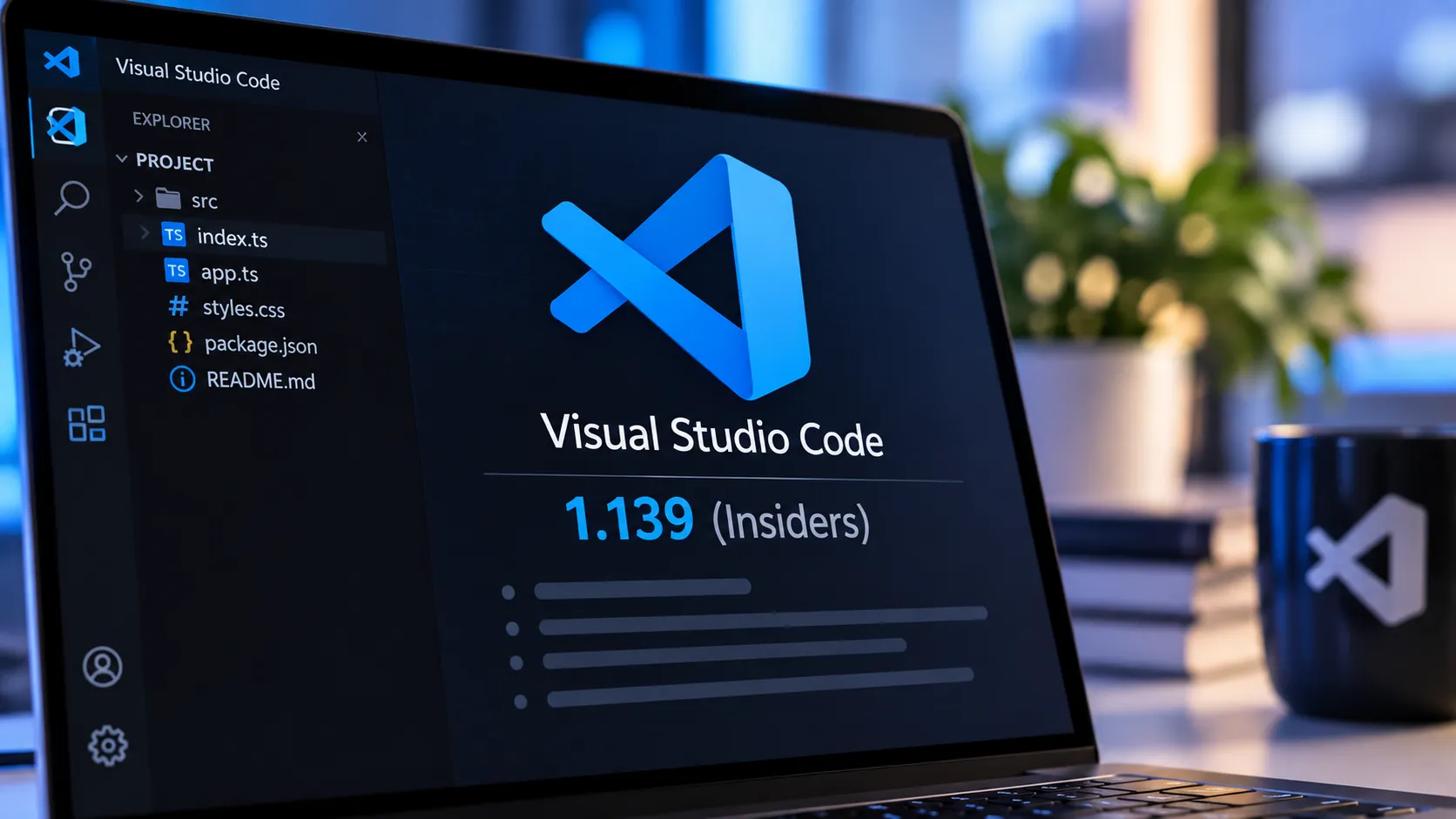
Microsoft released Visual Studio Code 1.139.0 to the Stable channel on September 23, 2026, replacing the sparse Insiders page that had appeared earlier in the month.
The official VS Code 1.139 release notes now include downloads for Windows, macOS, and Linux, along with a full changelog.
The biggest changes center on agent sessions, remote Dev Containers, and several smaller editor improvements.
Microsoft has already moved its Insiders channel to version 1.140, so 1.139 is no longer an upcoming or preview-only release.
Visual Studio Code 1.139.0 Is Stable Now
Microsoft labels the release:
Visual Studio Code 1.139
with a release date of September 23, 2026, and provides downloads for 1.139.0.
That clears up the naming distinction that existed while the page was still an Insiders placeholder.
The release-notes page uses 1.139 as the release family, while Microsoft's downloads and GitHub tag use the full 1.139.0 version number.
The Microsoft VS Code GitHub repository also lists 1.139.0 as the latest Stable release.
Users who already have VS Code installed can check for it through the application's normal Check for Updates command.
Anyone who wants features beyond 1.139 can use the separate Insiders channel, which has already moved to version 1.140.
Remote Dev Container Sessions Expand Beyond Local Projects
One of the largest changes is broader Dev Container support for agent sessions.
VS Code already allowed agents to work inside Dev Containers for local folders.
Version 1.139 extends that capability to projects hosted through:
SSH
Remote Tunnels
WSL
That means an agent can run inside the same containerized development environment as a remotely hosted project instead of requiring a duplicate toolchain on the local machine.
The feature uses:
chat.agentHost.devContainer.enabled
inside the Agents Window.
The remote project needs a supported Dev Container configuration, and Docker must be available on the remote host.
Microsoft says the feature is rolling out gradually, so it may not be enabled by default for every user immediately.
Anyone who wants to try it sooner can enable the setting manually.
Large Agent Session Lists Should Load Faster
Version 1.139 also changes how VS Code builds large agent-session lists.
Instead of opening every individual conversation database each time the list is refreshed, the agent host now keeps lightweight session and chat metadata in a central catalog.
Microsoft says full conversation content remains stored separately inside each session or chat database.
The performance improvement becomes more noticeable as the number of sessions grows.
In Microsoft's test with roughly 645 sessions:
The first session listing after launch fell from about 1.3 seconds to 0.1 seconds.
Refreshing the list dropped from about 0.6 seconds to 0.15 seconds.
Microsoft describes those results as roughly 12x faster for the first listing and 4x faster for refreshes.
Those are Microsoft's own development-machine measurements, not a guarantee for every installation.
Users with only a handful of agent sessions should expect a smaller difference.
Existing sessions migrate to the new catalog automatically in the background.
Agent Session Management Gets More Compact
Microsoft added several smaller changes around session organization.
A new Compact View fits more sessions onscreen by reducing the amount of information shown in each row until the user hovers over or focuses it.
Rows can expand automatically when a session needs input or approval.
Users can also hide empty custom groups and the empty Chats section through the session filter.
Session and nested-chat names can now be changed directly in the list.
Renaming works by:
Double-clicking the title.
Choosing Rename from the context menu.
Pressing F2 while the row is focused.
VS Code also prevents blank titles and restores the previous name if a rename is canceled.
A Preview setting, sessions.showChatTabs, lets users choose whether multiple chats inside one agent session appear as separate tabs or only show the currently active chat.
Word Wrap Is Easier to See
The editor itself gets a couple of smaller quality-of-life changes.
VS Code 1.139 adds word wrap indicators.
An arrow at the right-side wrap column shows when a long line continues onto another visual line, making wrapped text easier to distinguish from actual line breaks.
This is a visual change rather than a new wrapping system.
The underlying line remains one line in the file.
Bracket Auto-Closing Avoids More Duplicates
Microsoft also adjusted automatic bracket insertion.
When you type an opening bracket, VS Code now checks whether an appropriate closing bracket already exists.
If it does, the editor uses that one rather than inserting another duplicate closing character.
If no matching close exists, VS Code inserts one normally.
It's a small change, but one aimed at reducing extra brackets during editing.
Linux Users Should Check Pinned Launchers
The most important compatibility note in the release is specific to Linux.
VS Code's DEB and RPM packages now use reverse-DNS desktop file names.
For Stable builds:
code.desktopbecomescom.microsoft.VSCode.desktopcode-url-handler.desktopbecomescom.microsoft.VSCode.UrlHandler.desktop
Existing pinned launchers, favorites, custom shortcuts, and scripts that reference the old desktop file names are not automatically updated.
Microsoft warns that KDE Plasma users may see an error saying they are not authorized to execute the file when the real problem is that the pinned shortcut points to a desktop file that no longer exists.
The fix is to remove the old pinned launcher and add VS Code again from the desktop environment's application menu.
The code terminal command still works.
Reinstalling the package alone does not update saved references to the old desktop file names.
One Proposed API Targets Expiring Authentication Tokens
VS Code 1.139 also introduces a proposed authentication API for extension developers.
The authSessionExpiration proposal adds an optional expiresAfter value to AuthenticationSession.
That gives an extension information about how much lifetime remains on an access token.
The use case is long-running operations.
Without expiration information, an extension can either refresh a token unnecessarily or discover too late that it expired during a task.
The built-in Microsoft account provider already supplies the proposed value.
Because this is a proposed API, extension developers should not treat it like a finalized stable API yet.
What Happened to the Earlier Insiders Page?
Earlier in September, code.visualstudio.com/updates/v1_139 was labeled Visual Studio Code 1.139 (Insiders) and contained little more than a welcome line.
That page has since been replaced with the full Stable release notes.
Microsoft's release-notes archive now lists:
Visual Studio Code 1.140 (Insiders)
Visual Studio Code 1.139
Visual Studio Code 1.138
That sequence makes the current channel status clear.
Version 1.139 is Stable.
Version 1.140 is the active Insiders release.
How to Get Visual Studio Code 1.139.0
Microsoft provides official 1.139.0 downloads for:
Windows x64
Windows Arm64
macOS Universal
macOS Intel
macOS Apple silicon
Linux DEB
Linux RPM
Linux tar.gz
Linux Arm
Snap
The download links are available directly from the VS Code 1.139 release page.
If VS Code is already installed, use its built-in Check for Updates option rather than reinstalling manually unless there's a specific reason to do so.
Linux users who update through DEB or RPM should check any pinned launcher afterward because of the desktop-file rename.
What to Do Now
If you run Stable VS Code, version 1.139.0 is a normal production update, not an Insiders preview.
Update if you want the latest Stable fixes and improvements, particularly if you use agent sessions or remote Dev Containers.
Users with very large agent histories may see the biggest practical improvement from the faster session catalog.
Linux users should be ready to recreate stale pinned launchers after updating.
And anyone following the Insiders channel should stop using the 1.139 page as a preview tracker. Microsoft's active preview release is now Visual Studio Code 1.140.



Comments
Be the first, drop a comment!