





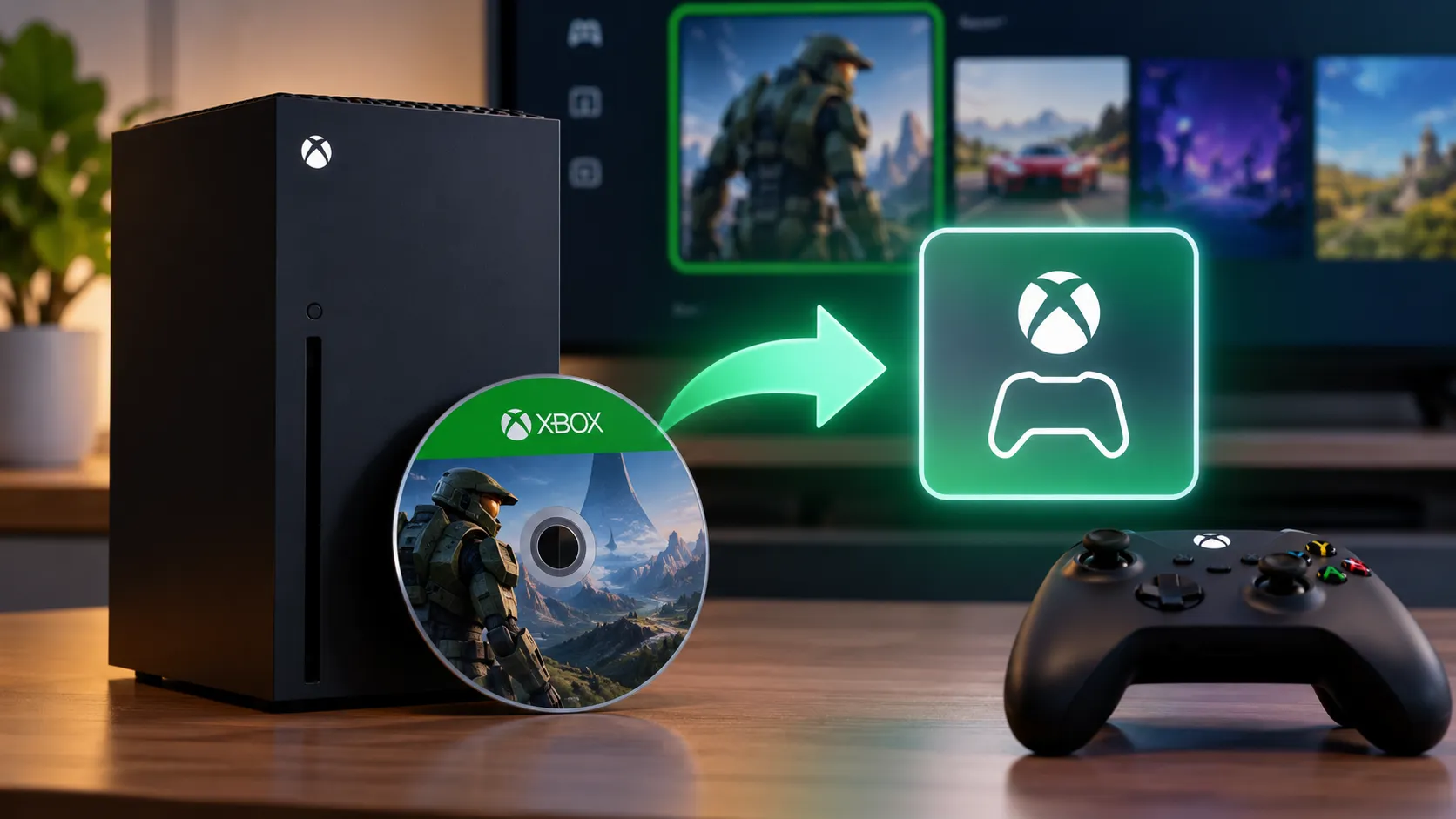
Xbox's disc-to-digital feature is now being tested across the Xbox Insider program, and the interesting part isn't simply that a physical game can unlock digital access.
The digital license remains tied to possession of the disc rather than becoming a permanent standalone purchase.
That distinction matters if you sell or lend a game. Microsoft's current digital-goods rules describe the entitlement as a limited-access license that depends on continued possession of the qualifying disc. If another player claims that disc, the previous holder can lose digital access.
Microsoft announced the feature Aug. 26 and began Insider testing Aug. 31. It initially appeared in the higher Xbox Insider rings before expanding across the Xbox Update Preview. Newly enrolled Insiders may still have to wait before the feature reaches their console.
Microsoft says most Xbox One and Xbox Series X disc games are eligible, starting with thousands of titles. Not every disc works, however, because eligibility can depend on technical, licensing and publishing requirements.
Who can use Xbox disc-to-digital right now?
The feature remains an Xbox Insider test rather than a general public release.
Microsoft's current Insider discussion thread says disc-to-digital is rolling out to members enrolled in the Xbox Update Preview. Testing has expanded beyond the original Alpha and Alpha Skip-Ahead groups to the lower Insider rings, although Microsoft warns that recently enrolled users may not receive access immediately.
Microsoft has not announced a public release date.
The entitlement can be claimed using a supported Xbox One or Xbox Series X disc inserted into a supported Xbox One or Xbox Series X console, according to Xbox's announcement.
Original Xbox and Xbox 360 discs are not part of the program. Some Xbox One discs can also fail the eligibility check because of technical differences in how they were manufactured.
Publisher participation is another limitation.
Early testing found that games from several major publishers were unavailable. Ubisoft titles began joining the program Sept. 9, including games such as Assassin's Creed Syndicate and Far Cry Primal. Current testing still shows some titles from Square Enix, Sega and Bandai Namco as not participating.
That means a publisher name alone is not enough to determine whether a specific disc works. Microsoft has not published a complete official compatibility database, so some discs still have to be checked individually.
How Xbox disc-to-digital works
The basic process is simple.
Insert an eligible Xbox One or Xbox Series X disc into a supported console while signed in to the account that should receive the license. The console can then grant a digital entitlement for the content on that disc.
Depending on the current Insider build, that can happen when the game is launched or through a Claim Digital License option associated with the game's tile.
Once the claim succeeds, the game can be launched digitally without leaving the disc in the drive while that entitlement remains valid.
Microsoft's Insider team notes that the Store may not show ownership of an equivalent digital bundle even after a successful claim. To see exactly what was granted, open Manage game & add-ons and check the licenses associated with the title.
The physical disc itself continues working normally.
What happens if you sell or lend the disc?
The digital license is not a permanent replacement for the physical copy.
Microsoft says a disc-to-digital license remains conditioned on continued possession of the qualifying disc. It cannot be transferred separately from that disc, and access can be suspended or revoked if the user no longer possesses it.
Hands-on testing also shows what that means when a disc changes hands: if another account claims the same eligible disc, the previous account's digital entitlement is revoked.
So if Account A claims a game, removes the disc and keeps playing digitally, then lends that disc to Account B, Account B can claim the entitlement. Account A then loses the disc-based digital access.
That preserves the basic resale and lending behavior of physical media. One disc does not create permanent digital ownership for multiple people.
There is one important correction to early reporting about verification. Microsoft previously told reporters there was no routine timeout requiring owners to keep reinserting the disc, but its current license terms reserve the right to require users to revalidate eligibility.
That means owners should not treat the entitlement as permanently verified after the first claim.
What you get after claiming a disc
A successful claim gives the game digital-library behavior while the license remains valid.
That can include Xbox Play Anywhere and Xbox Cloud Gaming where the particular title supports those services.
Xbox Play Anywhere does not automatically apply to every claimed game. The title itself must support Play Anywhere before a disc-based entitlement can extend to a compatible Windows PC or handheld.
Cloud gaming has another requirement. Claiming a disc does not by itself make cloud streaming free. Xbox Cloud Gaming currently requires an eligible Game Pass subscription for owned-game streaming.
Xbox has announced that beginning in November, players will also be able to buy cloud-playtime hours without a Game Pass subscription for eligible games they own.
Disc contents can be more complicated than the base-game license. Microsoft's Insider team says a successful claim can grant separate digital licenses for content included on the disc, and recommends checking Manage game & add-ons rather than relying on the Store page to show an equivalent bundle.
Microsoft also fixed an early testing bug Sept. 10 that could prevent additional disc content from working without the disc inserted when the base game was already owned digitally. The company identified Red Dead Redemption II and Battlefield 6 among affected titles.
Delisted games can work, but not all of them
One of the more useful parts of the test is support for some games that are no longer sold digitally.
Insider testing has shown that eligible physical copies of delisted titles can still generate digital licenses. Deadpool for Xbox One is one reported example.
That does not mean every delisted game works.
Microsoft's eligibility rules allow games or individual discs to be excluded for technical, licensing, publishing or other reasons. A title disappearing from the Store therefore does not automatically make its disc eligible or ineligible.
The feature also cannot restore online services that have already shut down. A digital entitlement provides access to the game content covered by the disc license, not discontinued servers or other external services.
Why this differs from Xbox's 2013 plan
Microsoft explored a much more restrictive physical-to-digital licensing model before the Xbox One launched in 2013. That plan became controversial partly because of proposed online checks and restrictions surrounding used games and lending, and Microsoft abandoned it before launch.
The current system preserves the physical disc's normal behavior.
Players can still install and play from the disc, lend it or sell it. The digital benefit follows the qualifying disc instead of permanently separating from it.
That makes the feature less like converting a physical game into a permanent digital purchase and more like attaching a movable digital entitlement to the disc.
Should you try it now or wait?
Try it now if the feature has reached your Xbox Insider Update Preview console and you have eligible Xbox One or Xbox Series X discs. Insert a disc and look for the digital-license claim option or launch the game to see whether the entitlement is granted.
Wait if you're not an Xbox Insider. Microsoft still describes the feature as a test and has not given a date for the general rollout.
Also wait before assuming a particular game works just because its publisher participates. Eligibility can vary by title and even by technical characteristics of the disc.
And don't treat a successful claim as permanent digital ownership detached from the physical copy. Microsoft's current rules make the license conditional on continued possession of the disc and allow eligibility to be revalidated.
The feature gives physical Xbox libraries many of the conveniences of digital ownership without eliminating resale or lending. The tradeoff is that the disc remains the key to the license, even when it is no longer sitting in the console.


Comments
Be the first, drop a comment!