Header Banner
Gadget Hacks Logo
Gadget Hacks
Windows Tips
gadgethacks.mark.png
Gadget Hacks Shop Apple Guides Android Guides iPhone Guides Mac Guides Pixel Guides Samsung Guides Tweaks & Hacks Privacy & Security Productivity Hacks Movies & TV Smartphone Gaming Music & Audio Travel Tips Videography Tips Chat Apps

Nature Publishes Formal Challenge to Microsoft Majorana 1 Quantum Claims

Nature Publishes Formal Challenge to Microsoft Majorana 1 Quantum Claims

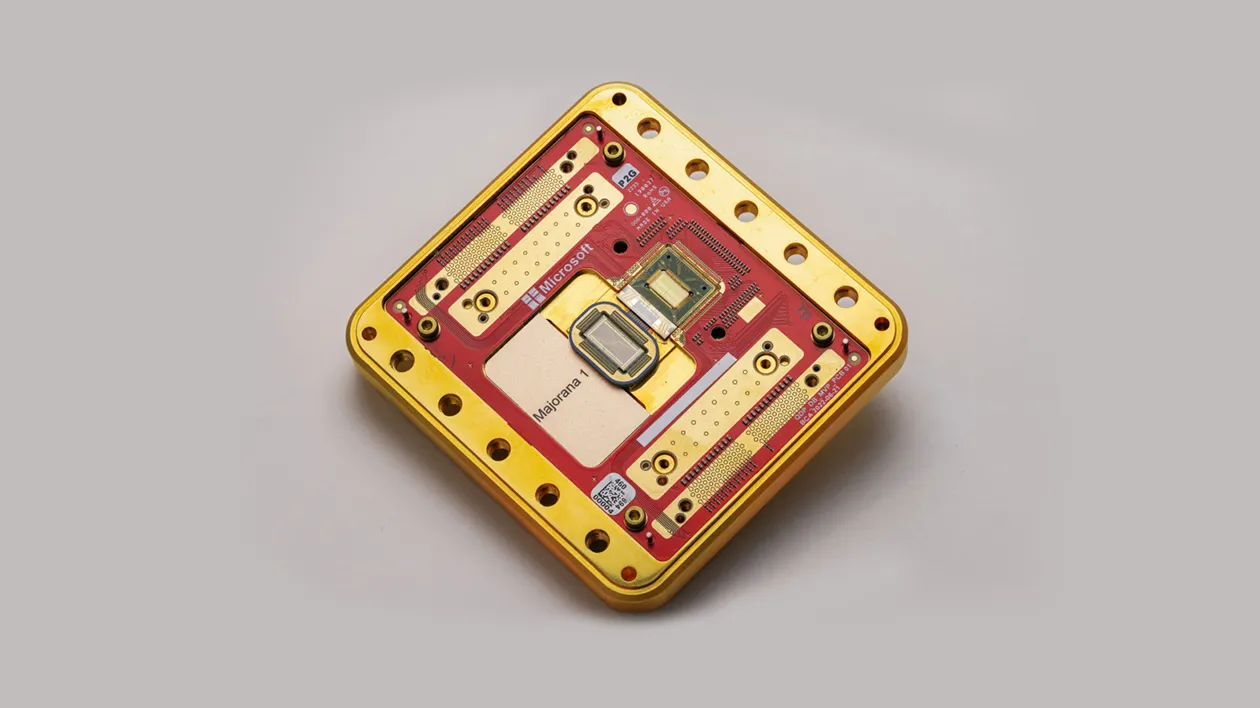
Nature published a peer-reviewed challenge to Microsoft's topological qubit program today, formally placing sixteen months of scientific skepticism into the permanent record. The critique, by Henry Legg of the University of St. Andrews, targets the Majorana 1 chip Microsoft unveiled in February 2025 as a quantum breakthrough. Microsoft's rebuttal appears in the same issue. Both sides knew this moment was coming, but the timing, three weeks after Microsoft announced a successor chip, makes the dispute harder to dismiss as routine academic friction.

Legg's paper landed in Nature's "Matters Arising" section, the journal's designated venue for formal challenges to previously published work. His core argument: Microsoft did not conclusively demonstrate a working topological qubit, and the software tool used to check its results contained coding errors that concealed data from peer reviewers. Microsoft disputes both claims and says it stands fully behind its results and roadmap.

The stakes are concrete. Quantum computing is already a multi-billion dollar industry, per BBC, and Microsoft's "years, not decades" framing shapes how investors, government partners, and policymakers weigh competing approaches. If the foundational physics behind that framing remains contested, decisions made on the basis of it rest on shakier ground than the press releases suggest.

How the gap between press release and peer review opened

Microsoft announced Majorana 1 in February 2025, describing it as a chip that would enable "a truly meaningful quantum computer not in decades, as some have predicted, but in years," as The Register reported. The language was unambiguous: arrival, not progress.

The journal publishing the underlying research took a different view. Nature's editors appended a note to Microsoft's own paper stating that "the results in this manuscript do not represent evidence for the presence of Majorana zero modes in the reported devices," the exact quantum states the entire approach requires, per BBC. A press release claiming a breakthrough; a journal note denying the foundational evidence. That gap was visible from day one.

Microsoft's design involves a semiconductor nanowire made of indium arsenide, thinner than a human hair, bonded to a superconductor. Theory predicts that electrons in this structure can collectively behave as Majorana particles, exotic quantum states that, if real, would make qubits inherently more stable and error-resistant, per The Verge. The company's entire approach depends on demonstrating those modes exist. That demonstration is precisely what remains in dispute.

At the time, Microsoft told reporters that additional evidence had been gathered after the paper's submission and would be presented at the American Physical Society's meeting the following March, according to archived Nature coverage. That evidence was presented. It did not persuade the researchers who attended. One physicist said the device "might be some sort of a qubit, but they can't control it," and saw no evidence it was topological. Another said she "wasn't convinced the data offered signatures of qubit behavior," per APS Physics.

None of this is entirely new territory for Microsoft. A paper from a Microsoft-backed lab claiming evidence of the Majorana particle was retracted by Nature in 2021, per BBC. When Microsoft unveiled Majorana 2 earlier this month, Vincent Mourik of Research Centre Jülich called it "another step in Microsoft's almost a decade-long track record of publishing unreliable results," as archived Nature coverage reported. That history is context for evaluating the current dispute, not proof of outcome, but a reason the bar for persuasion is higher.

Why the Microsoft Majorana 1 quantum claims are being challenged now

Legg's critique runs on two tracks: a scientific argument about what Microsoft's devices actually measured, and a procedural argument about how the data was handled.

On the science: Legg argues the signals Microsoft interpreted as Majorana evidence could instead come from quantum dots, ordinary electron-containing structures, or from material disorder in the device. Neither explanation would support the topological qubit claim. The measurement tool Microsoft used, the Topological Gap Protocol, was designed to detect Majorana signals while filtering out these alternatives. Legg argues it fails at that task. "You can't make a qubit if you don't have the Majoranas," he told The Verge.

The procedural argument is more concrete, and easier for non-physicists to evaluate. Legg contends Microsoft's tune-up software contained two Python errors that hid data from reviewers. The plotting code was hardcoded to display only the single largest region passing the protocol. Changing one parameter from [1] to [1,2] immediately revealed a second passing region. A separate error processed bias voltage data by array index rather than physical value, introducing a systematic distortion. If the software was filtering out other regions that passed the same protocol, the results reviewers evaluated may not represent the full picture of what the device actually showed.

When peer reviewers asked whether other passing regions existed, Legg says Microsoft told them only one had been found. "This was not correct," he wrote, per The Register.

Microsoft's rebuttal, published simultaneously in Nature, pushes back on both tracks. Chetan Nayak, who leads Microsoft's quantum hardware group, told The Verge that Legg has not "proposed an alternative model that fits all of our data," a legitimate scientific standard. The written response argues Legg focuses narrowly on transport measurements while ignoring the capacitance measurements Microsoft considers central to its case, and that the software "did not interpret the measurements" that drove its findings, per BBC. "We 100% stand behind our results," Nayak said.

Microsoft also points to DARPA advancing it to the final phase of its Quantum Benchmarking Initiative after independently evaluating its results, including proprietary data not available for public scrutiny, according to The Register. That represents institutional confidence from a credible evaluator. It is also a separate process from public peer review, and one the broader research community cannot independently examine.

Researchers attending the APS Global Summit pointed to X-measurements, tests for quantum superposition requiring a device to exist simultaneously in both 0 and 1 states, as the evidence that would carry more weight. Microsoft attempted X-measurements for Majorana 1 with disputed results. Some researchers say even more demanding experiments, such as directly observing the fusion of pairs of Majorana zero modes, would be needed for genuine confidence, per APS Physics. Neither standard has satisfied independent researchers.

The field is not uniformly hostile to the underlying science. Physicist Jason Alicea of Caltech said "the protocol has merit, and the concerns have merit," and called building topological qubits "a worthwhile goal," per APS Physics. The dispute is specifically about whether Microsoft has demonstrated what it claims, not whether the physics is worth pursuing.

Majorana 2 extends the roadmap without resolving the dispute

Three weeks before Legg's critique appeared in print, Microsoft announced Majorana 2. The company says it is 1,000 times more reliable than its predecessor and keeps the 2029 scalable quantum computer target on track. Legg argues it resolves nothing.

The Majorana 2 results appeared in an unreviewed preprint posted June 2, not a peer-reviewed paper. The preprint reports that the chip's device can hold a given parity state, whether the number of electrons it contains is odd or even, for more than 20 seconds, compared with milliseconds for its predecessor, per archived Nature coverage. Microsoft describes this as a 1,000-times reliability improvement.

Legg's objection is fundamental. What Majorana 2 demonstrates, he argues, is stable parity, not quantum superposition. The distinction matters. A classical computer bit can hold a stable state for years; that doesn't make it a qubit. "Their claim of '1,000 times more reliable' refers to the lifetime of a classical bit," Legg told The Register. "There is no evidence this is a qubit and can hold a superposition." Nayak disputes this directly, saying "parity lifetimes directly translate into qubit lifetimes," per archived Nature coverage.

The Majorana 2 preprint also does not include an X-measurement, the same test Microsoft eventually attempted for Majorana 1. Legg suggests this absence is telling: if the test was important enough to attempt last year, its omission from a follow-up announcement invites scrutiny. "Majorana 2 is not available to customers and it is not proven to even be a single qubit," he told The Register.

The 2029 target is now the concrete point of contention. "They simply cannot sell the 2029 roadmap as credible to the public when the underlying physics is not there," Legg told Scientific American.

What comes next

Nature's simultaneous publication of Legg's critique and Microsoft's rebuttal gives the field a cleaner basis for assessment than the informal skepticism circulating since early 2025. Both sides' arguments are now directly comparable in the same journal, as The Verge noted.

That doesn't resolve anything. Physicist Sergey Frolov of the University of Pittsburgh, who was not involved in either paper, told Scientific American the critique makes it "painfully apparent that the paper in Nature has no scientific value" and that it likely warrants retraction. No retraction process is currently indicated.

Three developments would shift the picture. Independent peer review of the Majorana 2 preprint would subject its claims to the same scrutiny now being applied to Majorana 1. A successful X-measurement demonstrating superposition that persuades researchers outside Microsoft would address the most direct gap in the existing evidence. Broader public data release would allow external teams to attempt replication. Until at least one of those occurs, the question at the center of this dispute, whether Microsoft's published evidence supports its public confidence, remains open, per APS Physics and The Register.

Apple's iOS 26 and iPadOS 26 updates are packed with new features, and you can try them before almost everyone else. First, check our list of supported iPhone and iPad models, then follow our step-by-step guide to install the iOS/iPadOS 26 beta — no paid developer account required.

Sponsored

Related Articles

Comments

No Comments Exist

Be the first, drop a comment!